Frequently Asked Questions
We offer a wide variety of doodle breeds:
Goldendoodles, Bernedoodles, Irish Doodles, Sheepadoodles, and MckNugget Mini-Doodles!
Our pups come in:
• Coat types –wavy & curly
• Colors – parti, tri-color, merle, deep red, and more
• Generations – F1 & F1B
• Sizes – from 15 to 100 lbs (breed dependent)
Have allergies or specific needs?
We’re happy to help you choose a coat type and generation that’s more allergy-friendly.
Contact us any time with questions about timing, allergies, or temperament.
Check out our Our Breeds to find out which breed is right for your family!
We’re based in Middletown, Virginia.
Out of state?
No worries! We offer transportation options.
Please reach out to us for a quote!
1. Pick Your Litter
Love a litter? Place a deposit to save your spot!
The deposit counts toward the total puppy price.
2. Get on the List
We go by deposit order—not gender or color.
Why? Because personality matters most!
We’re one of the few breeders in Virginia
who let you meet the puppies in person
before choosing—no picking from photos.
This helps you find the best fit for your family.
3. Puppies Are Here!
We’ll email when your litter is born.
Not enough pups? You can switch litters
or request a refund.
4. Take Home Day!
Pups go home around 8 weeks old.
We’ll give you 1–2 weeks’ notice
to plan your pick-up.
Need help with travel?
Ground Delivery + Flight Nanny available!
___
You can view our puppy process here!
Still have questions or want to talk through your situation? We’re happy to chat on the phone or have you visit during any scheduled take-home day! This gives you the chance to meet us, ask questions, see our process, and snuggle puppies. Please contact us with any questions or to schedule a visit!
We aim to stay competitive but fair in our pricing.
For detailed pricing info, check out our Pricing and Deposits page!
Each puppy will come with a take-home bag filled with goodies for you and your new fur baby!
Here’s what’s inside:
• Two-year genetic health guarantee
• Certificate of health from top reproductive health vets
• Vaccine & deworming records
• FROMM food sample
• Littermate scent towel
• Bandana & toy
• Bag of pine chips to help with potty training
• Sample of natural anti-parasite treatment
• Access to instructional video on natural diet & care
• A lifetime of free advice & support!
Family is at the heart of everything we do. McKenzie’s Doodles has been a family business for over 20 years, and our children and their families have been part of this journey in different ways. Some work full-time in the business, while others lend their talents and support. We love seeing our children and grandkids adore our pups just as much as we do.
Our “clans” help us stay organized behind the scenes. Our daughter, Hannah, and her husband Shannon lead the O’Shannah’s Doodles clan, and our son, Isaac, and his wife Kayla lead the Red String Farmstead clan. Although these are distinct businesses with some differences in how they breed and raise their litters, (ask for specific details on what your litter will be receiving!) we all operate under the McKenzie’s Doodles flagship and support each other as family with logistics, labor, and customer communications.
McKenzie’s Doodles has a Guardian Program that places our breeding dogs in private homes (their forever homes!) where they can live a normal life in a loving family instead of a kennel situation. Our parent dogs are placed as puppies and visit us when it’s time to breed and have their litters. The only draw back to the our program is that the parents are not available to be seen on demand. We do have photos, bios, and videos of all our Moms & Dads and we love to share updates from our Guardian Families on our social media pages!
When our parent dogs finish their time of service, they are already in their forever homes and permanent ownership is passed to their Guardian Families. From then on, they spend the rest of their lives in blissful retirement with their favorite humans!
We’re sorry your desired litter is full… but there’s good news! We take deposit reservations up to nine months in advance! We can take your deposit on an overflow basis, which means if a waitlisted family on your original preferred litter drops off for any reason (this happens frequently!) you will automatically be bumped upwards in the queue. Please contact us!
*Please note that there may be circumstances out of our control that may delay the arrival of the litter of your choosing. If this should occur, we will contact you right away to discuss your options.
This is always a question that is asked but the answer is much simpler than you might think. Bring a towel or two, just in case of an ‘accident’ by the puppy, and someone to hold him/her on the trip home. You will likely have no shortage of volunteers for this job! Most make it home without incident, but the towel will be ready in case they do not. Puppies do experience some separation emotions when leaving their littermates. It is a bit of a shock to them and they need all the snuggling and reassurance they can get!
Many people want to buy collars, leashes, crates, etc., before they come to pick up their pups. We think this is a good idea and we recommend that you do not take your puppy into a pet store until they’ve had three rounds of vaccinations. A good basic list of items to have on hand includes:
- Crate with a movable divider. The divider is EXTREMELY important – this is how a large crate can be made very small for a puppy. Please see our SUCESSFUL CRATE TRAINING process below!
- Good Quality Puppy Food – your puppy will currently be eating FROMM Large Breed Puppy (in the blue & gold bag). We feed all of our moms & dads (an our personal pets!) this brand as well and recommend it to all of our puppy families looking for a high quality food. You may also research quality brands on www.dogfoodadvisor.com – we recommend something in the 4-star range. Be sure to AVOID foods (and treats!) with pea protein, this is a cheap filler often put into dry dog food and NOT good for your dog’s health.
- Adjustable Collar – they grow FAST and a small adjustable collar will expand with them for several months. Collar should be about 10″ at its smallest and expand to about 15″ – this will take them through about 6 or 7 months.
- Name Tag – Petco and Petsmart have machines where you can engrave your pet’s name and more importantly your contact information. This is a simple precaution that will give you peace of mind.
- 6 Foot Leash
- Food and Water bowls (we recommend stainless steel)
- 4-5 inexpensive Bath Towels (put these in their crate, and just throw them in the laundry when they get soiled)
- Several Types of Toys – recommend stuffed animal, ball, squeak toy, and rope toy. Your puppy needs stimulation and is used to playing with their littermates. Toys will help.
- Slicker Brush
- Chew Treats – Always have on hand something for your puppy to chew on, such as bully sticks, Busy Heartyhide, Merrick Bones – if and when your puppy chews on something they shouldn’t, immediately exchange the item for one of these and tell them “NO – Chew on this instead!”
- Training Treats – we recommend the brand Pupford or any freeze-dried treats with minimal ingredients (be sure to avoid treats with fillers, pea protein, or unnecessary preservatives).
Crate training a puppy for the purpose of housebreaking them is my method of choice. It is a simple method that, if done right, secures a puppy’s potty habits from an early age and sets a standard of behavior they do not forget. The method is simple, but it is time consuming in the beginning. I cannot stress enough, however, how great the rewards are! There is nothing better than a well trained dog! The beginning is foundational to their whole life so it is of great importance. This is why I like to know ahead of time if someone is going to be home to do the work required before I send a puppy home. I want my customers as well as my puppies to have a great experience and the initial efforts are what set the stage. A well trained dog is like GOLD and everybody wins. That said, the Doodle is one of the fastest learners in dogdom. They have the setter/retrieve side that is so eager to please you and the poodle side that has the brains to back it up :)
More helpful information on crate training below.
Crate Training
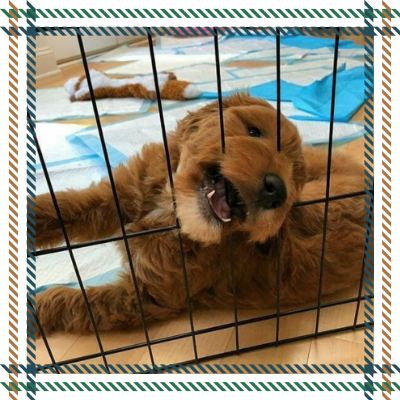
Setting the Stage
The first thing you will teach your puppy is that they can ‘hold it’. Up until this time they have relieved themselves as they desired, whenever they desired and wherever they desired. They have had no reason not to. Now it is your job to help them discover their ability to hold back the urge until the proper time and place has been reached. When you first bring your puppy home it is going to resent the crate and just want to be out with you doing what it has always done, play, eat, drink, poop and pee. It is up to you to get control of this in a kind and clear way.
First person up in the morning, take the puppy straight out! You may have to carry them for them to make it as they are not used to holding it and they will be ready to burst. Take the puppy outside to the spot that you want them to use when they relieve themselves. Try to stay consistent with this if you want their waste to stay in a restricted area. Until they have had their full three sets of shots it is best to restrict their outside time to your yard. After that they can go most anywhere for walks. Praise them heavily whenever they do their business. Use their names when praising, not when scolding.
The next step is to feed them, and take them back outside! Whoever controlls the food, controls the poop. Within minutes of eating solid food, the puppy’s food from the previous meal is now ready to be expelled….almost immediately! Always plan to take him out as soon as he is through eating! Watch him do his business, praise him, and bring back inside.
At this time, you can leave him out in a restricted area to play. Give him about 30-40 minutes and then PUT HIM BACK IN HIS CRATE. Make the total of this time, play time and crate time around 2 hours total. Do NOT take him out at the end of his play time. He needs to be in his crate where he does not want to soil after playing so he will learn to ‘hold it’. When he is out playing, he has no motivation to hold it, but in his crate he does.
At the end of the 2 hours, take the puppy back outside. Watch them do their business and then bring them in. If it’s feeding time, feed them and TAKE THEM BACK OUT. Watch them relieve themselves again and then bring them in for play time. As described above, let them play in a restricted area for about 20-40 minutes, then BACK IN THE CRATE. After a total of about 2 hours, do it all again. It will quickly move to longer times out and longer times they can stay in their crates without soiling.
In the beginning you should expect to have to get up with them in the night to take them out so you will need to place their crate near someone’s bed. This allows you to give them reassurance by your presence and to hear them when they tell you in the night they need to go out. This often is only for as few as a couple of days to perhaps 4-5 nights. After that they realize that they would rather sleep and they can wait until morning :) At the evening meal, try to feed them by 6 pm. This will not be an issue once they are solidly trained but until then it gives the meal time to move through them so they can eliminate it before being put in their crate for the night.
This is the basic pattern to follow. You will just judge by his success or failure if the timing is right or not. If he is responding, broaden his times a little at a time until he is finally safe to be out for hours playing. By the time he is 4 months old he should be able to be trusted out for several hours at a time and in his crate without soiling for 8-10 hrs at a time (mostly at night, these are VERY social dogs and should not be crated unless it is necessary and for as short a time as possible). By six months, most have the run of the house. Be careful, dogs are sneaky. They learn fast that you do not like them to do their business on the floor or inside so they will sneak off into a secluded part of the house to do it….don’t let them outsmart YOU!
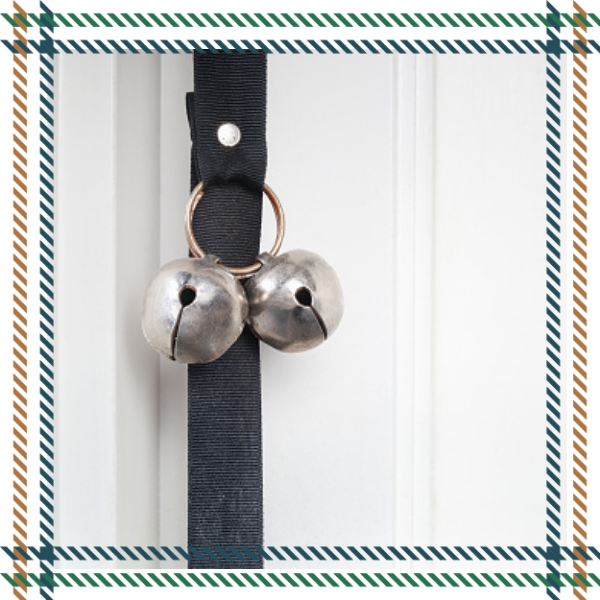
Using the Bell
One other idea that works well with these very smart dogs is ‘the bell’ . This is a bell or set of bells that you can hang near your door for them to ring when they need to go out. Every time you take them out, take their paw and ring the bells. Eventually, they will ring them themselves. Word of caution: they are very smart and figure out that they can go outside anytime they ring the bell.
Special Considerations
There are certain non-negotiables that have to be considered. First, a puppy will need to relieve himself EVERY time he/she eats, first thing in the morning (and I mean FIRST thing) and the very last thing at night before being put in his/her crate for the night. That said, he will need to pee even more often. The puppy needs to have water available to him at all times throughout the day to stay hydrated. This will mean frequent trips outdoors to pee, but should still be able to live within the 2 hour crate training cycles. Food is different though and can be controlled. When you put his bowl down for him to eat from, let him eat what he will. If he wanders off, pick it up, he is done. He will eventually realize he had better eat or it goes away. Do not offer it to him again until the next feeding, then do the same.
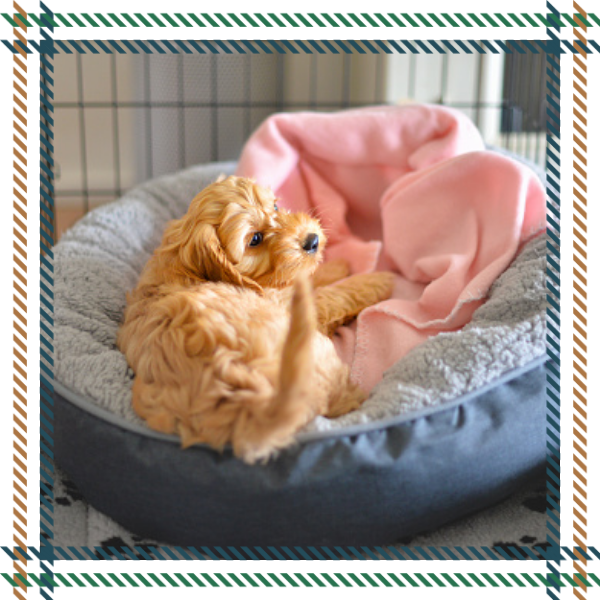
Final Thoughts
This process is very time consuming at first but, as we mention often, the rewards of a well trained dog are hard to measure! Hang in there, before you know it, you will have a puppy that you are greatly enjoying, and that everyone is very impressed with.